
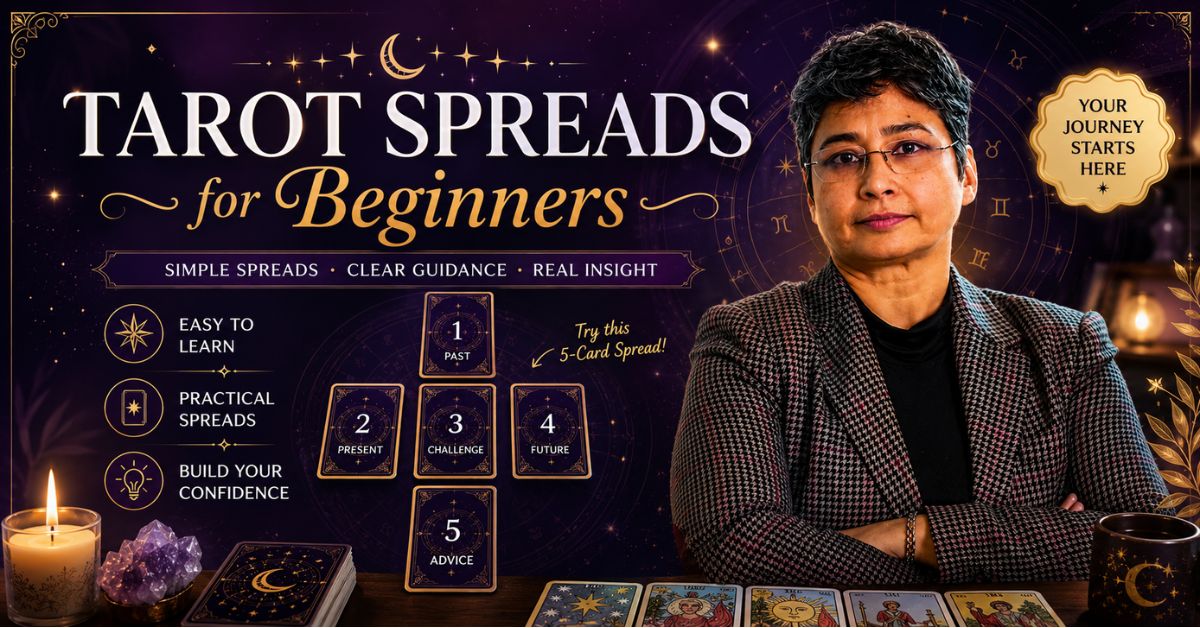
If you have recently picked up your first tarot deck and found yourself staring at 78 cards wondering where to begin, you are not alone. One of the first things every new reader asks is: how do I actually lay out the cards? The answer lies in understanding tarot spreads for beginners, and by the end of this guide you will have five ready-to-use spreads, a clear sense of what each one is for, and the confidence to start reading today.
A tarot spread gives your reading structure. Without one, you are simply pulling cards at random. With one, every card has a role, a position, and a meaning within the larger story the reading is telling. That structure is what separates an intuitive practice from a guessing game.
Whether you are looking for a quiet daily ritual, a framework for exploring your relationships, or a tool for working through a real decision, this tarot layout guide covers the spreads you need to begin. And if at any point you would prefer to experience a professional reading alongside your own practice, Tarot Guidance sessions with Mini Govil are available online across India in Hindi and English.
What Exactly Is a Tarot Spread?
A tarot spread is a predetermined layout in which each card position is assigned a specific meaning before any cards are drawn. Think of it as a framework for your question. Instead of pulling one card and hoping for clarity, a spread lets you break a situation into multiple angles: the past that shaped it, the present reality, what is hidden beneath the surface, the action being recommended, and the most likely outcome.
When you learn how to read tarot cards using spreads, each card earns its interpretation from its position as much as from its imagery. The same card placed in a “current challenge” position tells a different story than when it appears in the “potential outcome” position. This is the depth that tarot spreads for beginners need to understand from the very start.
Spreads range from a single card drawn at the start of the day to elaborate twelve-card layouts covering every dimension of a situation. For new readers, simpler is always better. Mastering a two or three card spread builds more genuine skill than fumbling through a ten-card layout before you know the individual card meanings.
If you want a solid grounding in the individual cards that appear in these spreads, read: The Major Arcana: A Beginner's Guide to the 22 Cards.
Why Using a Spread Makes You a Better Reader
Learning tarot without spreads is like learning to cook without a recipe. You might produce something workable by chance, but you will feel lost most of the time and struggle to repeat your successes.
Spreads prevent the most common beginner mistake: reading each card in isolation. When cards have defined positions, they speak to each other. The energy in position one shapes how you read position three. A difficult card in the “what to release” position carries a completely different message than the same card in the “outcome” position.
Most importantly, a defined spread keeps a reading honest. Without one, beginners often shuffle until a more hopeful card appears. A spread drawn in a single session respects the integrity of the message and builds the discipline that real tarot skill requires.
5 Tarot Spreads for Beginners You Can Try at Home Today
Spread 1: The One-Card Daily Tarot Spread
This is the single best place to start. A daily tarot spread is one card drawn each morning to set the theme, tone, or focus for the day ahead. It is fast, builds your card vocabulary one image at a time, and trains your intuition through consistent repetition.
How to do it: shuffle your deck while holding a clear intention. Ask something like: what energy should I be aware of today, or what do I need to pay attention to right now? Draw one card, place it face up, and spend a moment with the image before you open any guidebook. Your first impression is data.
This practice seems almost too simple, yet it consistently produces the most striking moments of accuracy for new readers. Over weeks and months, patterns emerge: recurring cards, themes that shadow a particular period, and signals that in hindsight were clear from the first draw.
For a deeper morning practice, read: How to Do a Daily One-Card Tarot Pull — and Actually Benefit From It.
Spread 2: The 3 Card Tarot Spread
The 3 card tarot spread is the most versatile layout in the tarot world. It delivers focused, meaningful answers across an enormous range of questions and is forgiving enough for a beginner to use confidently from the first session.
The classic format uses three positions: Past, Present, Future. The first card reveals the background or root cause of the situation. The second reflects where things stand right now. The third shows the most likely outcome if current energies continue.
What makes this spread exceptional for beginners is how easily the position meanings can be swapped to fit different questions. Here are four alternative formats you can use immediately:
- Mind, Body, Spirit: for wellbeing and balance readings.
- Situation, Action, Outcome: for decisions and dilemmas.
- What to Embrace, What to Release, What to Watch: for personal growth.
- You, The Other Person, The Relationship: for relationship questions.
The key rule with a 3 card tarot spread: decide your position meanings before you draw, not after you see the cards. Choosing meanings in response to what turns up is rationalisation, not reading. Define your layout, shuffle with intention, draw left to right, and interpret each card in its position before looking at the three as a whole.
The 3 card format is also how you begin to understand tarot spread meanings in practice. The same card in different positions tells different stories, and learning to navigate that distinction is the foundation of everything that follows.
Spread 3: The Love Tarot Spread
Questions about relationships are among the most common reasons people first pick up a tarot deck. A love tarot spread gives those questions structure, preventing the emotional charge of the topic from turning the reading into a search for reassurance rather than honest insight.
A simple five-card love tarot spread for beginners uses these positions:
- Card 1: How you are feeling in this situation.
- Card 2: How the other person may be feeling.
- Card 3: What is supporting the connection.
- Card 4: What is creating tension or a block.
- Card 5: The overall energy or direction of the relationship.
This layout works equally well for existing relationships, connections that have ended, and situations where you are deciding whether to move forward with someone new. The five positions ensure the reading is complete once all cards are drawn, which prevents the reshuffling trap.
A note on interpretation: challenging cards like The Tower, the Three of Swords, or the Five of Cups in a love spread are not verdicts. In a relationship context, they more often point to where healing is needed, what honest conversations have been avoided, or what patterns are ready to be released. Read them with curiosity rather than alarm.
Spread 4: The Problem and Solution Spread
When you are facing a specific challenge or decision and need more than a general overview, the problem and solution spread gives you a structured way to think it through. This is one of the most practically useful tarot spreads for beginners because it mirrors the way we naturally approach difficulty.
Use these four positions:
- Card 1: The core of the problem or the energy at the heart of the challenge.
- Card 2: What is making this situation harder than it needs to be.
- Card 3: What resource, strength, or perspective you already have available.
- Card 4: The path forward or the action the cards are guiding you to take.
This spread works well for career questions, creative blocks, relationship difficulties, and moments of feeling stuck. Pay close attention to the dynamic between card two and card three. The obstacle and the available resources are often more connected than they first appear.
If the cards in this spread raise a question you feel you cannot answer alone, or if the stakes of the decision feel genuinely high, it may be time to work with an experienced reader who can hold the situation objectively. You can book a personal reading with Mini Govil via WhatsApp, with sessions available in Hindi and English.
Spread 5: The Celtic Cross Tarot
The celtic cross tarot is the most recognised spread in the world and has been used for over a century. It covers ten positions that together address a situation from every angle: the present moment, what crosses or challenges it, the root cause, the recent past, what is possible, what is approaching, how you see yourself, how others see the situation, hopes and fears, and the final outcome.
While the celtic cross tarot is not labelled a beginner spread in most guidebooks, it is introduced here because many new readers are immediately drawn to it and because learning it in stages is entirely achievable. Here are the ten positions:
- Card 1: The present situation or central theme.
- Card 2: What crosses or creates tension with the situation.
- Card 3: The root cause or foundation.
- Card 4: What is moving away from the situation.
- Card 5: The best possible outcome or the aspirational energy.
- Card 6: What is approaching in the near future.
- Card 7: How you see yourself in this situation.
- Card 8: How others and the environment are influencing the situation.
- Card 9: Your hopes or fears.
- Card 10: The final outcome based on current energies.
The recommended approach for beginners: lay all ten cards face down, then turn them one at a time. Read each card fully in its position before moving to the next. Once all ten have been read individually, step back and look at the spread as a whole. What suits dominate? Are there multiple Major Arcana cards suggesting this is a significant life moment? Is the same energy appearing in multiple positions?
The celtic cross tarot is the spread used in Mini Govil's flagship Royal Astral Reading, which combines the full ten-card Celtic Cross with a complete Vedic Kundali analysis. If you are curious about how tarot and Vedic astrology work together, read Vedic vs Western Astrology: What's the Real Difference and Which One Is Right for You?.
Tips for Reading Tarot Spreads as a Beginner
These principles apply to every spread you use, from your first one-card pull to a full Celtic Cross:
- Set your intention before you shuffle. Hold your question clearly in your mind and let it guide the energy of the reading.
- Decide your spread and position meanings before you draw any cards. This keeps the reading structured and honest.
- Write your readings down. A tarot journal, even a simple notebook, is the fastest way to develop skill.
- Trust your first impression of each card before you reach for a guidebook. Your intuitive response is meaningful information.
- Review your readings after one or two weeks. The accuracy of a reading often becomes clearest with a little distance.
If you are ready to develop a structured practice beyond the basics, explore the tarot and astrology courses available through Mini Govil Astro Tarot House, designed to take you from beginner to confident reader with clear, step-by-step guidance.
When to Seek a Professional Tarot Reading
Self-practice with tarot spreads for beginners is a rich and rewarding habit, but there are times when reading for yourself becomes genuinely difficult. When a question is emotionally charged, when you notice yourself reshuffling for a different result, or when the stakes of a decision feel too high to read with objectivity, a professional reading provides the clarity that self-reading cannot.
The Royal Astral Reading at Mini Govil Astro Tarot House is a comprehensive 90-minute session that combines a complete Vedic Kundali birth chart analysis with a 12-card Celtic Cross tarot spread. It is designed for those at a significant crossroads in life and delivers insight across every major area simultaneously. Sessions are available online across India in Hindi and English.
Begin Your Tarot Journey One Spread at a Time
Learning to read tarot is not about memorising 78 card definitions before you ever sit down with a deck. It is about building a relationship with the cards through consistent, curious, and open-minded practice. The five spreads in this guide give you a clear progression: start with a daily single card, move into the versatile 3 card tarot spread, explore the love spread and problem-solving layout, and when you are ready, take on the full celtic cross tarot.
Every confident tarot reader was once exactly where you are now. The difference between those who develop real skill and those who give up is simply this: the skilled readers stayed consistent, stayed curious, and trusted that every reading was teaching them something, even when the message was not immediately clear.
About Mini Govil
Mini Govil is a Vedic astrologer and tarot reader with over 10 years of experience, having guided more than 5,000 clients across India. She offers personalized readings in Hindi and English. Learn more at miniastrotarot.com.