
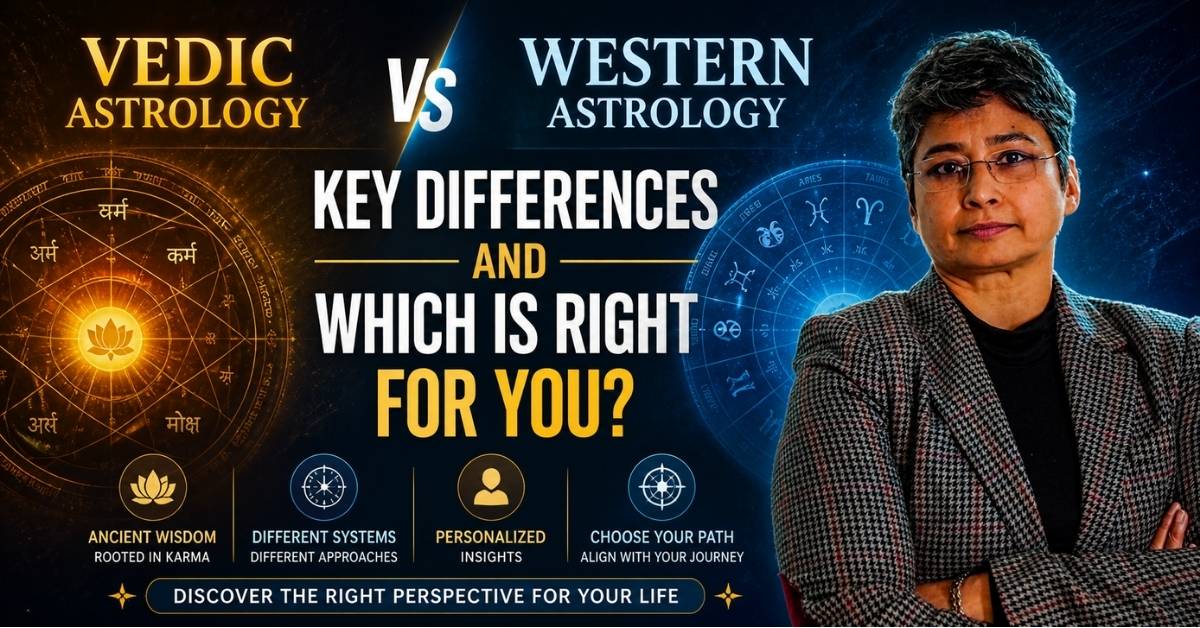
If you have ever searched for your zodiac sign and then heard an Indian astrologer tell you something completely different, you are not alone.Millions of people around the world are discovering that there are two major systems of astrology — Vedic and Western — and that they can point to entirely different signs, interpretations, and life predictions.
This guide breaks down the core differences between Vedic astrology vs Western astrology in plain language — covering the sidereal zodiac, tropical zodiac, kundali reading, moon sign, nakshatra, and more — so you can make an informed choice about which system resonates with your life.
What Is Western Astrology?
Western astrology is the system most people in Europe and the Americas are familiar with. It is the one behind the zodiac columns in magazines and newspapers where your birth month determines whether you are a Scorpio, a Taurus, or a Gemini.
Western astrology is based on the tropical zodiac, which is tied to the seasons of the Earth. The zodiac begins at the Spring Equinox (around March 21), which is always the first degree of Aries. This means the signs are anchored to the relationship between the Earth and the Sun, not to the actual position of the stars in the sky.
In Western astrology, your Sun sign receives the most emphasis. It represents your core identity, ego, and life purpose. The rising sign (Ascendant) and the positions of other planets are also considered, but the Sun is the dominant feature of most Western chart readings.
Western astrology also incorporates modern planets — Uranus, Neptune, and Pluto — which were discovered in the last three centuries and have no equivalent in classical Vedic texts.
What Is Vedic Astrology?
Vedic astrology, also known as Jyotish astrology or Indian astrology, is one of the oldest astrological systems in the world. It originates from the Vedas, the ancient sacred texts of India, and has been practiced and refined over thousands of years.
Unlike Western astrology, Vedic astrology uses the sidereal zodiac, which is based on the actual, observable positions of the stars in the sky. Because the Earth wobbles on its axis over time (a phenomenon called the Precession of the Equinoxes), the tropical and sidereal zodiacs have gradually drifted apart over centuries. Today, there is approximately a 23-to-24 degree difference between the two systems — which is roughly equivalent to one full zodiac sign.
This is why your Vedic Sun sign is often one sign behind your Western Sun sign. For example, someone born under Western Aries may actually be a Pisces in Vedic astrology.
In Vedic astrology, the Moon sign carries far more importance than the Sun sign. The kundali reading — a detailed birth chart based on your exact date, time, and place of birth — forms the foundation of Jyotish analysis. The rising sign (called the Lagna) is also given great weight, as it determines the structure of all twelve houses of life.
To understand how the Moon sign shapes your emotional world in the Vedic system, read: What Your Moon Sign Says About Your Emotional World.
Tropical Zodiac vs Sidereal Zodiac: The Core Technical Difference
The single biggest technical difference between the two systems is the starting point of the zodiac.
- Tropical Zodiac (Western): Starts at 0 degrees Aries at the Spring Equinox. It is season-based and moves with the Sun.
- Sidereal Zodiac (Vedic): Starts at 0 degrees Aries aligned with the actual position of the Aries constellation in the sky. It is star-based and accounts for the Earth's axial wobble.
Because the Earth's axis shifts by approximately 50 arc seconds per year (completing one full cycle in around 26,000 years), the two zodiacs were once aligned around 285 CE but have since drifted apart. Vedic astrology corrects for this drift using a value called the Ayanamsha, which currently sits at roughly 23 to 24 degrees.
The result is that your planetary positions will often look entirely different on a Vedic chart compared to a Western one not because one is wrong, but because they are measuring fundamentally different things.
The Role of the Moon Sign in Vedic Astrology
In Western astrology, when someone asks what your sign is, they are almost always asking about your Sun sign. In Vedic astrology, the Moon sign or Rashi holds primary importance for daily life, emotions, mental patterns, and relationships.
The Moon moves through each zodiac sign approximately every two and a half days, making it highly personal and sensitive to your exact birth time. In Vedic tradition, the Moon sign is considered the most accurate reflection of your mind, emotional tendencies, and habitual responses to life.
This is also why two people born on the same day can have radically different personalities in the Vedic framework because their Moon signs may differ, and the Moon is the primary lens through which their personalities are read.
The Moon sign is also used to calculate the Nakshatra, a system of 27 lunar mansions unique to Vedic astrology that offers extremely precise insights into personality, destiny, and timing.
What Are Nakshatras and Why Do They Matter?
The nakshatra system is one of the most distinctive and powerful features of Jyotish astrology. The 360-degree zodiac in Vedic astrology is divided into 27 equal lunar mansions of 13 degrees and 20 minutes each. The Moon's position at the moment of your birth determines your birth nakshatra and this is used to derive your Dasha (planetary period) timeline, your compatibility with potential partners, and the name syllable traditionally given to newborns in Hindu culture.
Each nakshatra has its own deity, symbol, ruling planet, and set of qualities. For example:
- Ashwini- ruled by Ketu, associated with healing, speed, and new beginnings.
- Rohini- ruled by the Moon, associated with beauty, abundance, and sensuality.
- Jyeshtha-ruled by Mercury, associated with power, seniority, and protection.
There is no equivalent to the nakshatra system in Western astrology. It is one of the primary reasons Vedic astrologers can be extraordinarily specific about timing and personality going far beyond what a Sun sign reading can offer.
What Is a Kundali Reading?
A kundali reading, also called a Janam Kundali or birth chart, is the core diagnostic tool of Vedic astrology. It is a precise map of the sky at the moment of your birth, charted to your exact time and place of birth.
The kundali shows the positions of all nine classical Vedic planets (called Grahas) the Sun, Moon, Mars, Mercury, Jupiter, Venus, Saturn, Rahu, and Ketu across the twelve houses of life. Each house governs a different area: career, relationships, wealth, health, spirituality, and more.
Reading a kundali involves analysing:
- The Lagna (Ascendant): The rising sign at the time of birth, which sets the structure of the entire chart.
- The Dasha System: A unique planetary period system that maps out which planet governs each phase of your life and for how long.
- Yogas:Specific planetary combinations that indicate strengths, challenges, and potential outcomes in different life areas.
- Doshas:Planetary afflictions such as the widely discussed Mangal Dosha that are considered in marriage compatibility and life planning.
A Western astrology chart also uses the twelve houses and planetary positions, but it does not use the Dasha system or nakshatras, and the house positions will differ due to the sidereal vs tropical gap.
Rising Sign: Lagna in Vedic vs Ascendant in Western Astrology
Both systems use the rising sign, the zodiac sign appearing on the eastern horizon at the exact moment of your birth. However, they treat it quite differently.
In Western astrology, the Ascendant is one of three key chart pillars (alongside the Sun and Moon signs). It represents your outer personality and the first impression you make on the world.
In Vedic astrology, the Lagna (rising sign) is arguably the most important point in the entire kundali. It determines which house each planet falls in, which areas of life each planet governs, and how the entire chart is read. Two people with the same Moon and Sun sign but different Lagnas will have completely different chart readings.
Because of the sidereal vs tropical difference, your Vedic Lagna will often differ from your Western Ascendant sometimes by a full sign or more. This can completely change the story your chart tells.
Key Differences at a Glance
- Zodiac System: Western uses the Tropical Zodiac (season-based). Vedic uses the Sidereal Zodiac (star-based).
- Primary Focus: Western emphasises the Sun sign. Vedic emphasises the Moon sign and the Lagna (rising sign).
- Planets Used: Western uses 10 planets including Uranus, Neptune, and Pluto. Vedic uses 9 classical Grahas including Rahu and Ketu (the lunar nodes).
- Timing System: Western does not use a fixed timing system equivalent to Dashas. Vedic uses the precise Vimshottari Dasha system for life timing.
- Lunar Mansions: Western has no equivalent to the nakshatra system. Vedic astrology divides the sky into 27 nakshatras.
- Origin and Tradition: Western astrology has Greek and Hellenistic roots. Vedic astrology originates from the ancient Indian Vedic tradition.
- Compatibility Matching: Western uses synastry charts. Vedic uses the elaborate Ashtakoot (Guna Milan) system based on Moon signs and nakshatras.
Which Astrology System Is Right for You?
The honest answer is that neither system is universally superior. They serve different purposes and approach the human experience from different angles.
Vedic astrology tends to excel at:
- Precise life timing: The Dasha system allows a skilled Jyotish practitioner to identify specific windows for major events: a career change, a marriage, a period of illness with remarkable accuracy.
- Karmic and spiritual insight: Vedic astrology is deeply rooted in the concepts of karma, dharma, and moksha. If you are drawn to understanding your soul's journey and purpose, Jyotish astrology offers extraordinary depth.
- Practical daily guidance: The Moon sign and nakshatra system are used for everyday decision-making in traditional Indian households from naming a child to choosing a wedding date.
Western astrology tends to excel at:
- Psychological depth: Modern Western astrology has absorbed significant influence from Jungian psychology. It is particularly strong for understanding personality patterns, shadow work, and emotional growth.
- Accessibility: The Western system is widely available in English and has a large community of practitioners globally.
- Outer planetary transits: Uranus, Neptune, and Pluto absent from Vedic astrology are considered by many Western practitioners to be powerful generational and transformational forces.
If you grew up in India or have a strong connection to Hindu tradition and spirituality, Vedic astrology will likely feel deeply resonant. If you are drawn to psychology-based self-inquiry, the Western approach may offer a natural starting point. Many serious students of astrology ultimately study both.
Should You Get a Vedic Kundali Reading?
If you have never had a proper kundali reading, it is worth experiencing at least once. A skilled Vedic astrologer will not simply tell you your Sun sign and leave it at that. They will map out the entire architecture of your birth chart: your Lagna, Moon sign, planetary positions in all twelve houses, the Dasha period you are currently in, and the specific yogas and doshas present in your chart.
The insights from a thorough kundali reading can be surprisingly specific touching on your career trajectory, relationship patterns, financial timing, health tendencies, and spiritual path.
A Note on Accuracy: Why Your Birth Time Matters
Whichever system you choose, accuracy of your birth details matters enormously. Your rising sign (Lagna in Vedic, Ascendant in Western) changes approximately every two hours. An error of even thirty minutes in your birth time can shift your entire chart.
For a kundali reading, the most precise results come from knowing your exact birth time, date, and place of birth. If your birth time is unknown, a skilled practitioner can use a technique called birth time rectification cross-referencing known life events with planetary positions to estimate your correct chart.
Final Thoughts
The debate around Vedic astrology vs Western astrology is less about which is right and more about what kind of wisdom you are seeking. Both systems are sophisticated, time-tested, and capable of offering genuine insight when practised by a skilled astrologer.
Vedic astrology, with its sidereal zodiac, nakshatra system, Dasha timing, and emphasis on the Moon sign and kundali reading, offers a uniquely precise and spiritually rich framework particularly for those seeking concrete timing, karmic understanding, and a connection to India's ancient Jyotish tradition.
Western astrology, with its tropical zodiac and psychological orientation, offers a deeply accessible and reflective lens for self-understanding.
Whichever path you choose, the stars are not there to limit you. They are there to reveal what is already within you.