
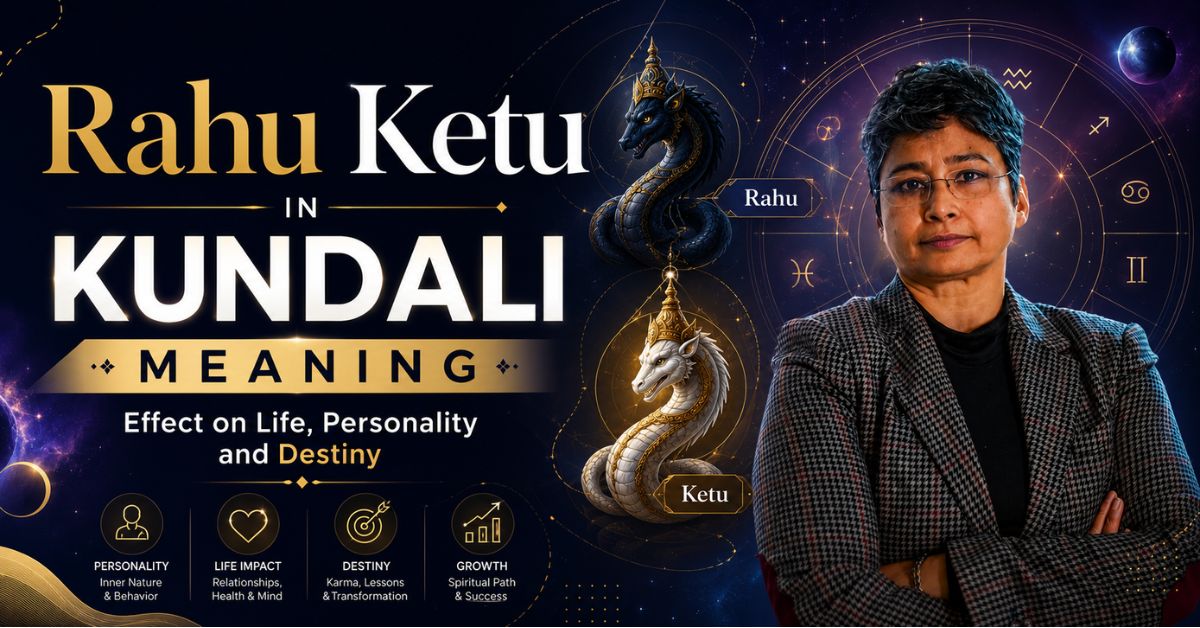
There is a moment in almost every Vedic astrology reading when the conversation shifts. The astrologer moves away from your Sun sign and your Moon sign and turns instead to two shadowy points on the chart that have no physical body, no visible form, and yet hold an enormous amount of power over the direction of your life. Those two points are Rahu and Ketu.
Understanding the rahu ketu in kundali meaning is not simply an academic exercise. For millions of people across India and beyond, these two nodes represent the clearest cosmic map of where you have come from and where your soul is trying to go. If you have ever felt pulled in two directions at once, drawn towards something you cannot explain, or held back by patterns you cannot seem to break, Rahu and Ketu may be speaking to you.
If you are new to Vedic astrology and want to understand the broader system first, you may find it helpful to read Vedic vs Western Astrology: What's the Real Difference and Which One Is Right for You? before continuing.
What Are Rahu and Ketu? The Shadow Planets Explained
In Vedic astrology, Rahu and Ketu are not planets in the conventional sense. They are the two lunar nodes, the points where the orbit of the Moon intersects with the apparent path of the Sun around the Earth. Rahu is the North Node of the Moon, also called the ascending node, and Ketu is the South Node, also called the descending node. In Western astrology they are known as the north node and south node, but in the Vedic system they carry a mythology and weight that goes far beyond any Western interpretation.
They are referred to as Chaya Grahas in Sanskrit, meaning shadow planets. They have no physical mass, no light of their own, and yet they are considered full planets within Jyotish astrology and are given their own Mahadasha periods in the Vimshottari Dasha system. Rahu governs an 18-year Mahadasha period. Ketu governs a 7-year period. Together they account for 25 of the 120 years of the full Dasha cycle.
In the sky, Rahu and Ketu are always directly opposite each other, 180 degrees apart. This means wherever Rahu sits in your Kundali, Ketu will be in the exact opposite house. They always move in retrograde motion, travelling backwards through the zodiac, which is another reason they are considered unusual and uniquely powerful.
The Mythology Behind Rahu and Ketu
To truly grasp the rahu ketu in kundali meaning, you need to understand the story behind them. According to Hindu mythology, during the great cosmic churning of the ocean called the Samudra Manthan, the demon Svarbhanu disguised himself among the Gods and drank the divine nectar of immortality. The Sun God and the Moon God recognised him and alerted Lord Vishnu, who severed his head with the Sudarshana Chakra.
But Svarbhanu had already swallowed enough nectar to become immortal. His severed head became Rahu and his body became Ketu. Both survived. And because the Sun and Moon had betrayed him, Rahu periodically swallows them during solar and lunar eclipses, causing them to temporarily disappear from the sky before releasing them. This is why eclipses in Vedic tradition are considered highly significant karmic events.
This mythology is deeply instructive. Rahu is a head with no body, all desire and appetite with no capacity for digestion or completion. Ketu is a body with no head, all sensation and instinct with no direction or purpose. Together they represent the axis of karma, the unresolved desires of past lives pulling you forward and the accumulated wisdom of previous existences holding you back.
Rahu in Your Kundali: The North Node and Future Karma
Rahu represents everything your soul has not yet mastered in this lifetime. It is the direction you are being asked to grow into, even if that direction feels uncomfortable, unfamiliar, or intensely compelling. The house and sign where Rahu sits in your Kundali reveals the area of life where you will experience the greatest desire, the most intense ambition, and often the most significant challenges.
Rahu magnifies. Whatever it touches in your chart, it amplifies beyond normal proportion. If Rahu sits in your second house of wealth, you may find yourself intensely focused on money and accumulation, never quite feeling enough no matter how much you earn. If it sits in your tenth house of career, your professional ambitions may drive you with an almost obsessive force.
Rahu is also associated with foreign lands, technology, unconventional thinking, and the breaking of taboos. People with a powerful Rahu in their chart are often drawn to fields that are innovative, disruptive, or ahead of their time. They can become extraordinarily successful, but only once they learn to channel Rahu's energy consciously rather than being consumed by it.
The Rahu Mahadasha effects are among the most discussed topics in Vedic astrology. An 18-year period governed by Rahu can be a time of extraordinary ambition, sudden rises in fortune, and intense worldly engagement. But it can also bring confusion, illusion, and a sense that you are chasing something that keeps shifting just beyond reach. If you are currently in your Rahu Mahadasha and would like to understand how it is affecting your chart specifically, a personalised Vedic astrology consultation with Mini Govil can map out exactly what this period holds for you.
Ketu in Your Kundali: The South Node and Past Life Karma
Where Rahu pulls you forward, Ketu holds the residue of your past. The house and sign where Ketu sits represents your accumulated karma from previous lifetimes, qualities and experiences you have already mastered to such a degree that they now feel strangely hollow or effortless. Ketu is the place in your chart where you feel detached, disinterested, or disconnected, not because those things are unimportant but because your soul has already been there.
Ketu is deeply spiritual in nature. It governs liberation, renunciation, intuition, and the dissolving of ego. Many of the great saints and spiritual masters in Indian history have had powerful Ketu placements. Ketu brings moksha, the liberation from the cycle of birth and death, and those with strong Ketu often feel a pull towards meditation, spiritual practice, and withdrawal from the material world.
However, Ketu also brings isolation, sudden losses, and a strange sense of incompleteness in the area of life it touches. This is not punishment. It is the soul saying that these experiences have already been lived, and it is time to look elsewhere for growth.
Ketu in the 7th House: Relationships and Detachment
One of the most frequently discussed placements in karmic astrology is Ketu in the 7th house. The seventh house governs marriage, long-term partnerships, and the quality of your one-to-one relationships. When Ketu sits here, it brings a complex and often confusing energy to the realm of love and commitment.
People with Ketu in the 7th house often find that relationships feel somehow incomplete or unfulfilling despite their best efforts. They may attract partners who are spiritually inclined, unconventional, or difficult to hold onto. There can be a recurring pattern of connection followed by separation, a deep longing for union alongside an equally deep pull towards solitude.
In the context of past life astrology, Ketu in the 7th house suggests that the soul has spent many previous lifetimes in deep partnership, perhaps as a devoted spouse, a committed lover, or a loyal companion. The soul has already mastered the lessons of relationship to a certain degree, and this lifetime is inviting it to develop independence, self-reliance, and an inner completeness that does not depend on another person for wholeness.
This does not mean people with Ketu in the 7th house cannot have successful marriages. Many do. But their relationship journey is rarely simple, and the spiritual lesson underlying their experiences is almost always about learning that love must begin within.
Rahu and Ketu as Karmic Astrology Tools
The reason Rahu and Ketu are so central to past life astrology India is that they represent the karmic axis of the soul with extraordinary precision. No other element in the Kundali maps the journey of the soul across lifetimes in quite the same way.
Rahu points to where you are going. Ketu shows where you have been. The tension between these two points in your chart is the tension of your entire evolutionary journey as a soul. Learning to work consciously with that tension, moving towards what Rahu demands while drawing on the wisdom that Ketu has already accumulated, is the central spiritual challenge of your incarnation.
In practical terms, this means that the houses and signs of Rahu and Ketu in your birth chart contain some of the most important information about your life's purpose, your repeating patterns, and the direction your soul most needs to grow. Planets that conjoin or aspect Rahu and Ketu are particularly important, as they become deeply intertwined with the karmic themes of your chart.
If you are curious about what your Moon sign reveals about your emotional patterns and how it interacts with your nodal axis, the article on What Your Moon Sign Says About Your Emotional World offers a helpful companion perspective.
Rahu Ketu Transit 2025 and 2026: What It Means for You
Rahu and Ketu transit through each pair of opposite signs approximately every 18 months, spending a total of roughly 18 years completing a full cycle through the zodiac. Their transits are considered among the most significant astrological events in Vedic astrology, capable of triggering major life changes, spiritual awakenings, and course corrections at a collective and individual level.
The Rahu Ketu transit that began in late 2023 placed Rahu in Pisces and Ketu in Virgo within the Vedic sidereal zodiac, a placement that continues to shape the collective experience through 2025 and into 2026. Rahu in Pisces heightens collective spiritual seeking, dissolving of boundaries, and experiences of illusion and inspiration in equal measure. Ketu in Virgo draws attention to issues of health, service, detail, and the need to release perfectionism and over-analysis.
At a personal level, the impact of this transit depends entirely on where Pisces and Virgo fall in your individual Kundali. If this transit activates your first and seventh houses, your sense of identity and your relationships are being deeply reworked. If it touches your fourth and tenth houses, your home life and career are in significant transition. Understanding exactly how this transit affects your chart requires a close look at your personal birth chart.
For a detailed reading of how the current Rahu Ketu transit is moving through your Kundali, you can book a Vedic astrology session with Mini Govil for a precise and personalised interpretation.
How to Work With Rahu and Ketu in Your Life
Understanding the rahu ketu in kundali means one thing. Knowing how to work with these energies consciously is another. Here are some practical principles for integrating the nodal axis into your daily awareness.
Lean into Rahu, gently
Rahu's house represents your growing edge. The discomfort you feel in this area of life is not a sign that something is wrong. It is a sign that your soul is expanding. Gently stepping towards the experiences that Rahu invites, whether that means pursuing a career in an unfamiliar field, exploring a new culture, or engaging with technology and innovation, can accelerate your growth significantly.
Draw on Ketu's wisdom without getting stuck there
Ketu represents your accumulated strengths. It is tempting to retreat into what feels natural and comfortable, but Ketu's house should be a resource rather than a refuge. Use the skills and wisdom you carry from past lifetimes as a foundation for moving towards Rahu's call, not as a reason to stay where you are.
Spiritual practice helps with Ketu
Ketu is deeply aligned with meditation, prayer, and inner work. If you are experiencing a Ketu transit through a sensitive part of your chart, or if you are in your Ketu Mahadasha, spiritual practice can be one of the most stabilising things you can do. Ketu's energy dissolves ego, and conscious spiritual practice helps make that dissolution feel like liberation rather than loss.
Remedies and rituals for shadow planet astrology
In Vedic tradition, the shadow planets respond to specific remedies. Rahu is traditionally associated with the blue sapphire's substitute hessonite garnet (Gomed), and its energy can be balanced through Rahu mantras, donations on Saturdays, and practices that reduce ego-driven desire. Ketu is associated with the cat's eye gemstone (Lahsuniya) and responds to practices that foster spiritual surrender and detachment.
However, gemstone recommendations in Vedic astrology are highly individual and should only be made by a qualified astrologer after reviewing your complete birth chart. The wrong gemstone can amplify problems rather than solving them.
Rahu and Ketu in the Twelve Houses: A Quick Guide
While a detailed analysis of every house placement is beyond the scope of this article, here is a brief guide to the core themes Rahu and Ketu activate in each house pair.
- Rahu in 1st / Ketu in 7th: Strong ego-drive and individuality; lessons around independence versus partnership.
- Rahu in 2nd / Ketu in 8th: Intense focus on wealth and speech; past life experiences of transformation and loss.
- Rahu in 3rd / Ketu in 9th: Drive for communication and courage; release of rigid belief systems from past lives.
- Rahu in 4th / Ketu in 10th: Desire for home and emotional security; past life mastery of career and public status.
- Rahu in 5th / Ketu in 11th: Creative ambition and desire for recognition; release of social group attachments.
- Rahu in 6th / Ketu in 12th: Drive towards service and problem-solving; spiritual gifts and tendencies towards isolation from previous lives.
- Rahu in 7th / Ketu in 1st: Intense focus on partnerships; past life mastery of independence and self-identity.
- Rahu in 8th / Ketu in 2nd: Fascination with mystery and transformation; past life comfort with wealth and stability.
- Rahu in 9th / Ketu in 3rd: Hunger for philosophy, travel, and higher learning; past life facility with communication and skill.
- Rahu in 10th / Ketu in 4th: Powerful career ambitions; past life rooted in home and emotional comfort.
- Rahu in 11th / Ketu in 5th: Drive towards community and large goals; past life talents in creativity and children.
- Rahu in 12th / Ketu in 6th: Pull towards foreign lands, spirituality, and the hidden; past life experience of service and discipline.
Getting Your Rahu and Ketu Read Professionally
Reading about Rahu and Ketu gives you the framework. But seeing exactly how these nodes function in your specific Kundali, in combination with your Lagna, your Moon sign, and the planets that aspect or conjoin them, is a completely different level of understanding. A skilled Vedic astrologer can tell you not only where Rahu and Ketu sit in your chart but also which Dasha period you are currently moving through, how the current Rahu Ketu transit is affecting your houses, what remedies are most appropriate for your chart, and what the nodal axis is specifically asking of you in this incarnation.
Mini Govil offers personalised Vedic astrology consultations focused on exactly this kind of deep chart analysis. Sessions are available in Hindi and English, over call or video, and can be booked easily via WhatsApp. Whether you are in the middle of a Rahu Mahadasha, navigating a difficult Ketu transit, or simply want to understand the karmic map your soul is working with, a personalised kundali reading is the clearest way to get those answers.
Final Thoughts: The Shadow Planets and Your Destiny
Rahu and Ketu are among the most misunderstood elements in Vedic astrology, often reduced to warnings or feared as malefic forces. But their true function is neither punishment nor misfortune. They are the soul's compass, the cosmic indicators of where you have been and where you are going.
The rahu ketu in kundali meaning is ultimately a story of evolution. Every chart has a nodal axis. Every soul has a karmic direction. And every moment of restlessness, longing, or inexplicable pull you feel in your life may be Rahu and Ketu doing their job: nudging you towards the experiences your soul signed up for long before you arrived in this body.