
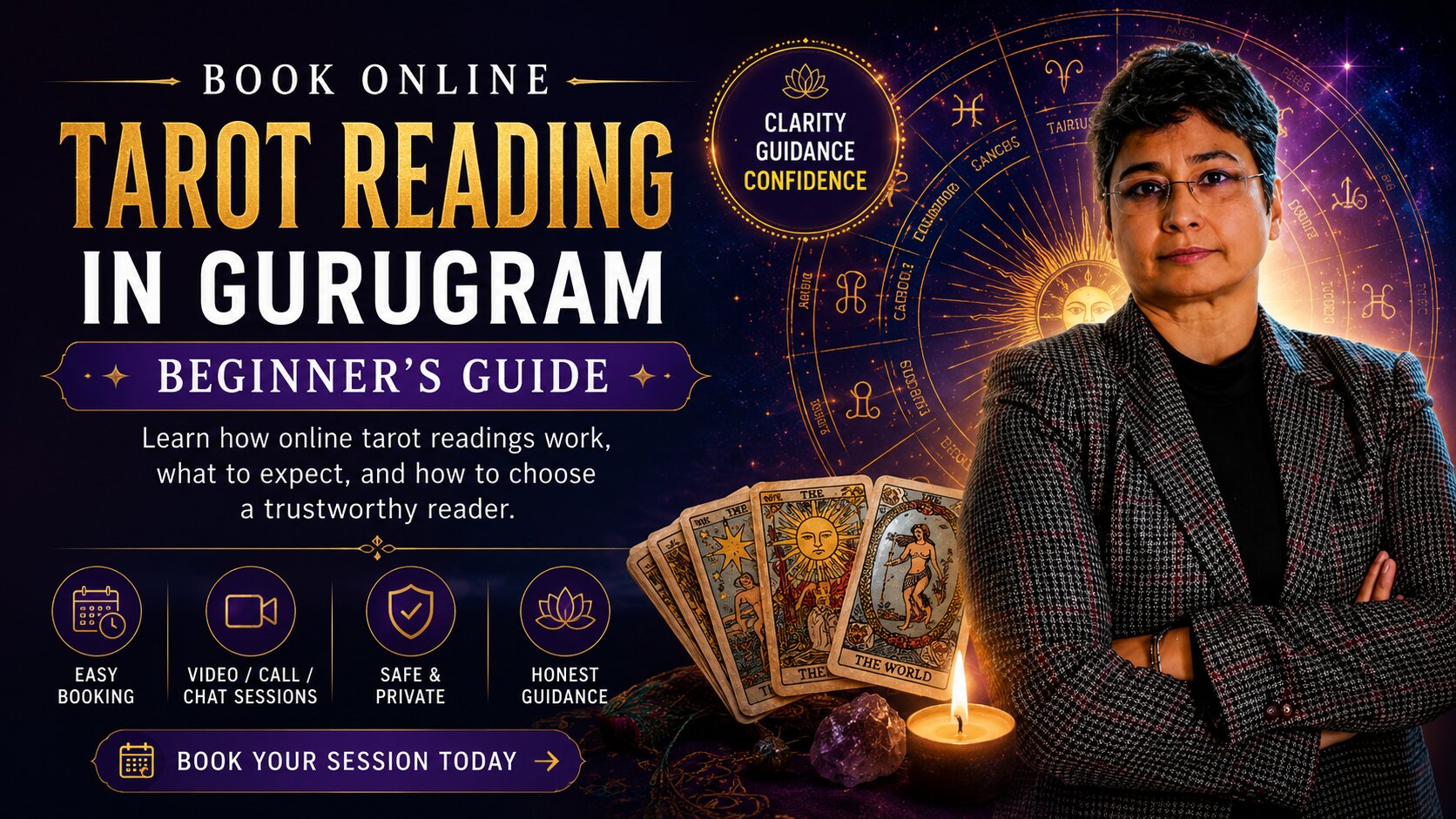
Have you ever felt stuck on a decision and wished someone could just hand you a little clarity? That’s usually the moment people start looking into tarot reading. If you’re searching to book an online tarot reading in Gurugram, you’re probably not looking for magic. You’re looking for a fresh perspective on something that’s been on your mind.
This guide walks you through everything you need to know before you book your first session — what tarot actually is, how online readings work, what to expect, and how to avoid reading services that rely on fear instead of genuine guidance.
What Is Tarot Reading, Really?
Tarot reading is the practice of using a deck of 78 illustrated cards to explore questions about your life. Each card carries a symbolic meaning, and the way cards are laid out and combined helps a reader offer insight into a situation you’re facing.
Think of tarot cards like a mirror with different angles. Each card reflects a possible perspective on your question — not a fixed prediction carved in stone. A skilled reader doesn’t tell you what will happen. They help you see what’s already happening beneath the surface, so you can make a clearer decision.
The Origin of Tarot Cards
Tarot began in 15th-century Europe as a card game before it evolved into a tool for reflection and guidance in the 18th century. The deck is divided into two parts:
- Major Arcana (22 cards): These represent big life themes — change, growth, endings, new beginnings.
- Minor Arcana (56 cards): These reflect everyday matters — work, money, relationships, emotions — divided into four suits, similar to a regular playing card deck.
How Tarot Differs from Astrology
This is one of the most common points of confusion, so let’s clear it up simply.
| Aspect | Tarot Reading | Vedic Astrology |
|---|---|---|
| Basis | Symbolic cards drawn in the moment | Your exact birth date, time, and place |
| Focus | Present situation and near-term guidance | Life patterns, timing, and long-term cycles |
| Best for | Specific, immediate questions | Understanding broader life direction |
| Nature | Reflective and intuitive | Calculated and chart-based |
Neither is “better” than the other. They simply answer different kinds of questions. Some people book both — a Kundli reading for the bigger picture, and a tarot session for something specific happening right now.
Why People in Gurugram Are Turning to Online Tarot Readings
Gurugram is one of the busiest corporate hubs in the country, and that pace of life shapes how people seek guidance too.
The Convenience Factor for a Fast-Paced City
Between long commutes on the Golf Course Road stretch, late meetings, and a packed calendar, finding time to visit a reader in person isn’t always realistic. Booking online means you can have a session during a lunch break, after work, or even on a Sunday morning without leaving your home.
Privacy and Comfort of Reading from Home
A lot of people feel more comfortable opening up about personal matters — a relationship doubt, a career decision, a family situation — from their own space rather than a public setting. Online readings remove that hesitation. You’re speaking from your own room, at your own pace, in a setting where you feel safe being honest.
How an Online Tarot Reading Actually Works
If you’ve never done this before, the process is simpler than most people expect.
Step-by-Step Process
- Choose your reading type – career, relationship, or general guidance.
- Book your slot – most readers offer video call, phone call, or chat-based sessions.
- Share your question (optional) – some readers ask you to note your main concern beforehand so the session stays focused.
- The card draw – the reader shuffles and draws cards live, often on video so you can see the process.
- Interpretation and discussion – the reader explains what the cards suggest, and you can ask follow-up questions.
- Notes or recording – many services offer a summary or recording of the session afterward.
A typical session lasts between 30 and 60 minutes, depending on how many questions you bring.
What You Need Before Your Session
- A stable internet connection if it’s a video call
- A quiet space where you can speak freely
- One or two clear questions written down beforehand
- An open mind — tarot works best as a conversation, not a verdict
Types of Tarot Readings You Can Book Online
Not every reading serves the same purpose. Here’s a breakdown of what’s typically available.
Career and Business Readings These focus on questions like whether to take a new job offer, how a business decision might unfold, or what’s blocking progress at work. The cards don’t guarantee outcomes — they highlight patterns, risks, and opportunities you might be overlooking.
Love and Relationship Readings People often book these when they’re unsure about a relationship’s direction, considering a breakup, or wondering how to communicate better with a partner. A good reader will focus on your patterns and choices, not make promises about another person’s feelings or actions.
General Life Guidance Readings These are open-ended sessions for people who don’t have one specific question but want a broader check-in on where their life is heading. It’s a good starting point if you’re new to tarot and just want to see how it feels.
Common Myths About Tarot Reading (Busted)
Tarot carries a lot of baggage from movies and pop culture. Let’s separate fact from fiction.
Myth: The Death card means someone is going to die. Reality: The Death card almost always represents an ending that makes way for something new — a job change, the end of a phase, a relationship shift. It’s about transformation, not literal death.
Myth: Tarot can predict exact events with certainty. Reality: Tarot reflects tendencies and possibilities based on your current path. It’s not a fixed prophecy. Your choices after the reading still shape the outcome.
Myth: You need to believe in tarot for it to “work.” Reality: Many people approach tarot simply as a structured way to reflect on a problem, similar to journaling with a guided prompt. Belief isn’t a requirement to gain value from the conversation.
Myth: A reader who tells you bad news is more “authentic.” Reality: A trustworthy reader explains challenges alongside possibilities, and always frames guidance in terms of choices you can make — not fear you should carry.
How to Choose the Right Online Tarot Reader in Gurugram
Since anyone can call themselves a tarot reader online, it helps to know what separates a genuine, ethical service from one that isn’t.
Questions to Ask Before Booking
- How long have you been reading professionally?
- What does a typical session include?
- Do you offer a recording or written summary?
- How do you handle sensitive topics like health or death?
Red Flags to Watch For
- Promises of guaranteed outcomes (“You will definitely get married by next year”)
- Pressure to book multiple expensive follow-up sessions to “remove a curse”
- Refusal to explain their process or card meanings
- Reluctance to give you a clear price before the session
A reliable reader will explain their approach openly, keep pricing transparent, and never use fear to push you toward buying more sessions.
What Happens During Your First Tarot Session
Your first session is usually the most important one, because it sets the tone for whether tarot feels useful to you.
Expect the reader to start with a short conversation about what’s on your mind. This isn’t small talk — it helps them understand the real context behind your question. From there, they’ll draw cards in a specific layout, called a “spread,” based on your question. A simple three-card spread (past, present, future) is common for beginners, while more detailed spreads are used for complex questions.
Throughout the session, you should feel like you’re part of a two-way conversation, not being talked at. If something doesn’t resonate with your situation, it’s completely normal to say so — a good reader will explore that further with you rather than insisting they’re right.
Tarot Reading vs Vedic Astrology: Which One Do You Need?
This is one of the most searched questions among people exploring both practices, so it deserves a direct answer.
If your question is about a specific, current decision (“Should I take this job offer?” or “Is this relationship worth continuing?”), tarot is often the more focused tool.
If your question is about long-term timing (“When is a good period for marriage in my life?” or “What does my career path look like over the next decade?”), a Kundli-based astrology reading works better, since it maps your birth chart over time.
Many people in Gurugram actually use both — astrology for the big-picture timeline, and tarot for the smaller, situational questions that come up along the way.
How to Prepare Your Questions for a Tarot Reading
The quality of a reading depends heavily on the quality of your question. Vague questions get vague answers.
- Instead of: “Will I be successful?” → Try: “What should I focus on to grow in my current role this year?”
- Instead of: “Does he love me?” → Try: “What’s blocking clear communication between us right now?”
Specific, self-focused questions almost always lead to more useful, actionable guidance than broad yes-or-no questions.
Common Mistakes First-Time Clients Make
- Asking about other people’s private choices instead of their own path. Tarot works best when it’s about your decisions and actions.
- Booking during a moment of panic. A calmer state of mind leads to a more productive conversation.
- Treating the reading as a final verdict rather than one input among many in a decision.
- Not asking follow-up questions. If a card’s meaning isn’t clear, ask the reader to explain it in the context of your life.
Understanding Tarot Card Meanings (Beginner Basics)
You don’t need to memorize all 78 cards to benefit from a reading, but knowing a few basics helps you follow along.
Did You Know? The four suits of the Minor Arcana each represent a different area of life:
- Cups – emotions, relationships, feelings
- Pentacles – money, career, material matters
- Swords – thoughts, conflict, decisions
- Wands – ambition, energy, action
Quick Summary:
- Major Arcana = big life themes
- Minor Arcana = everyday situations
- Upright cards = the energy is flowing naturally
- Reversed cards = the energy is blocked, delayed, or turned inward
How Often Should You Get a Tarot Reading?
There’s no fixed rule, but a helpful guideline: avoid booking repeat sessions for the exact same question within a short span, since the situation likely hasn’t changed enough to shift the guidance. Many people find value in a reading every few months, or specifically when facing a genuine crossroads — a job change, a relationship decision, or a major life transition.
Key Takeaways
- Tarot reading uses symbolic cards to reflect on present situations, not to predict fixed outcomes.
- Online tarot readings offer privacy, flexibility, and convenience — especially useful for Gurugram’s busy professional lifestyle.
- A typical session includes a conversation, a live card draw, and an interpretive discussion, usually lasting 30–60 minutes.
- Specific, self-focused questions produce far more useful readings than vague ones.
- A trustworthy reader never guarantees outcomes or uses fear to sell extra sessions.
- Tarot and Vedic astrology serve different purposes — tarot for immediate questions, astrology for long-term timing.
Common Questions
Frequently Asked Questions
Is online tarot reading as accurate as in-person reading?
+
Yes, the format doesn't change how the cards are interpreted. What matters more is the reader's experience and how clearly you communicate your question, whether you're sitting across from them or on a video call.
How much does an online tarot reading in Gurugram usually cost?
+
Pricing varies by reader experience and session length, generally ranging from a basic short session to a more detailed, extended consultation. Always confirm pricing before booking to avoid surprises.
Can tarot reading tell me exactly when something will happen?
+
Not precisely. Tarot reflects current patterns and possibilities rather than exact dates. For timing-specific questions, Vedic astrology, which uses your birth chart, is generally more suited.
Do I need to prepare anything before my session?
+
Just one or two clear, specific questions and a quiet space to talk. You don't need any prior tarot knowledge.
What if I don't believe in tarot — can I still book a session?
+
Yes. Many people approach it simply as a structured way to think through a problem with an outside perspective, without needing to hold a particular belief system.
Is it normal for a reading to feel uncertain or vague at times?
+
Some ambiguity is normal, since tarot reflects tendencies, not certainties. A good reader will work with you to relate the cards to your specific situation rather than leaving you with vague statements.
Can I ask about someone else during my reading, like my partner or family member?
+
You can, but readings are generally most useful when focused on your own choices and actions, since that's what you have direct control over.
How long does an online tarot session usually last?
+
Most sessions run between 30 and 60 minutes, depending on how many questions or topics you want to cover.
What's the difference between booking a tarot reading and an astrology consultation?
+
Tarot addresses a specific, present-moment question using card symbolism. Astrology uses your birth details to map broader life timing and patterns. They can complement each other well.
Should I be worried about a reading predicting something negative?
+
An ethical reader presents challenges alongside possibilities and practical guidance, never as fixed, frightening outcomes. If a session ever feels designed to scare you into booking more sessions, that's a sign to look elsewhere.